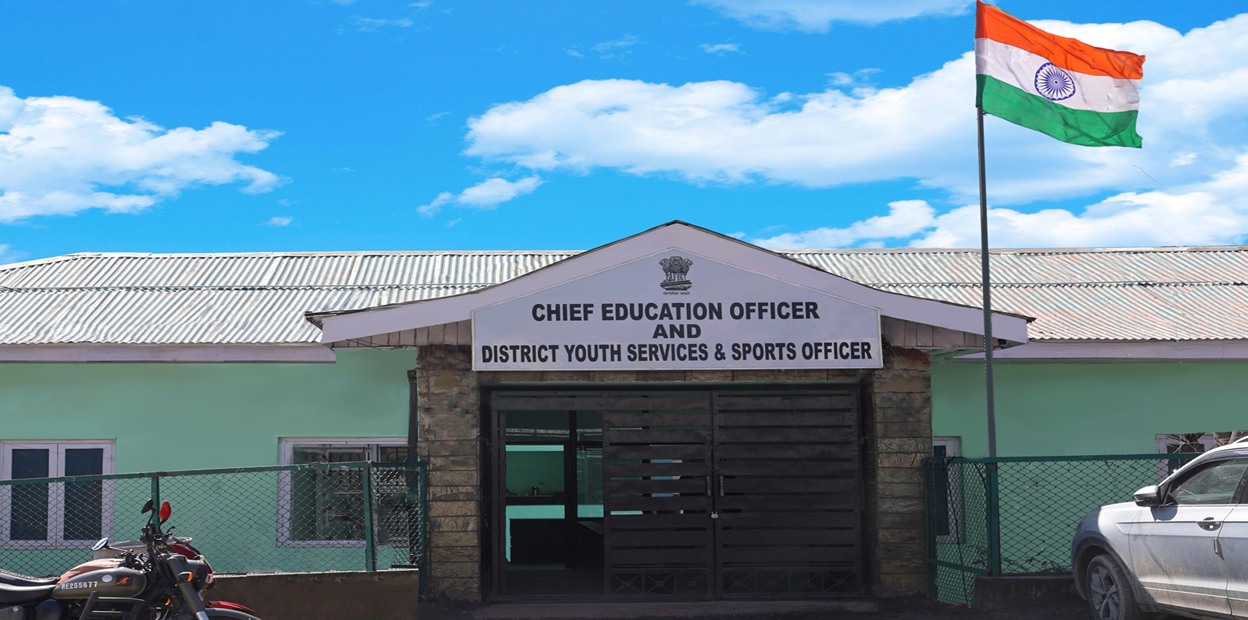
Chief Education Office, Doda
Established in 1942 as the District Education Office and renamed the Chief Education Office (CEO) Doda in 1993, the Office of the Chief Education Officer, Doda is the apex district-level authority responsible for the planning, implementation, supervision, and monitoring of school education across the district.
The office works in close coordination with the Directorate of School Education, Jammu, and other allied departments to ensure equitable, inclusive, and quality education for every child. At present, it oversees a vast network of 1,133 government schools and 271 private schools, implementing educational policies and initiatives of both the State and Central Governments. The mandate of the Chief Education Office, Doda spans academic administration, teacher management, infrastructure development, student welfare schemes, digital initiatives, and community engagement, with special focus on remote and underserved areas. The office ensures effective policy execution through timely dissemination of guidelines, institutional support, and continuous progress monitoring. In addition, the office manages resource allocation, including funds and infrastructure projects, to strengthen the education system and enhance learning environments. It also plays a key role in the professional development of teachers and staff through training programmes, workshops, and seminars aimed at improving teaching standards and enriching classroom practices.
Through evidence-based planning, transparent governance, and continuous monitoring, the Chief Education Office, Doda serves as a vital platform for addressing educational challenges and fostering positive change. It remains central to the district’s educational framework, committed to improving learning outcomes and ensuring access to quality education for every child, thereby shaping the future of coming generations.
District Education Statistics
Official snapshot of schools, students and staff
Government Schools (Category-wise)
Private Schools (Category-wise)
Government Students (Enrolment)
Private Students (Enrolment)
Staff Distribution (Government)
Record Management System (RMS)
A secure, role-based digital platform that digitizes, manages, and provides controlled access to departmental records — including public-facing documents like orders, circulars, and notifications.
Complete Digitization & Archiving
Seamless upload, scanning, and indexing of legacy records with full-text search and long-term digital preservation.
Role-Based Secure Login
Multi-level access control with audit logs, ensuring internal security and compliance.
Public Document Portal
Citizens and stakeholders can securely view, search, and download orders, circulars, and notifications online.
Analytics & Monitoring Dashboard
Real-time insights into record usage, digitization progress, and access patterns for efficient administration.
Integrated Management System (IMS)
A unified, all-in-one platform combining School, Employee, Student, Attendance, and Budget Management — delivering real-time, department-wide administrative control in a single secure system.
School Management System
Complete oversight of infrastructure, enrollment, academic performance, and compliance across all institutions.
Employee & Student Management
Centralized HR and student records with biometric attendance, leave tracking, and real-time status updates.
Attendance & Leave Automation
Biometric and mobile-based attendance with instant synchronization and automated payroll integration.
Budget & Financial Reporting
End-to-end budget planning, expenditure tracking, and dynamic MIS reports for audit-ready transparency.
AASHA – Digitising Access to Education
AASHA is a district-wide digital platform designed to identify, track, and mainstream Out-of-School Children (OOSC) through a fully digitised, end-to-end workflow — from household surveys to school enrollment and retention.
Household-Level Surveying
Door-to-door surveys across all blocks with GPS tagging and photo capture, ensuring comprehensive identification of out-of-school children.
Multi-Role Workflow System
Structured workflows for DNO, ZNO, planners, surveyors, and school heads, enabling coordinated action at every administrative level.
Multi-Level Verification
Data validation across multiple levels ensures accuracy before enrollment, eliminating duplication and errors.
Offline Field Capability
Surveyors can collect and store data without internet connectivity, with seamless synchronization when online.
Real-Time Monitoring & Enrollment
Live dashboards and direct routing of verified children to nearby schools, enabling timely enrollment and continuous progress tracking.
Mandate & Responsibilities
Academic Administration
Curriculum implementation, examinations, and academic quality assurance.
Human Resource Management
Deployment, service matters, and training of teachers and staff.
Infrastructure Development
Construction, maintenance, and upgradation of school facilities.
Scheme Implementation
Execution and monitoring of student welfare and education schemes.
Digital Initiatives
Promotion of digital learning and MIS-based governance.
Monitoring & Compliance
Inspections, audits, and regulatory compliance.
Key Achievements
Improved Enrollment
Increased enrollment and retention, especially in remote areas.
Infrastructure Upgrade
New classrooms, libraries, toilets, and ICT labs across the district.
Digital Governance
Online systems for records, reporting, and monitoring.